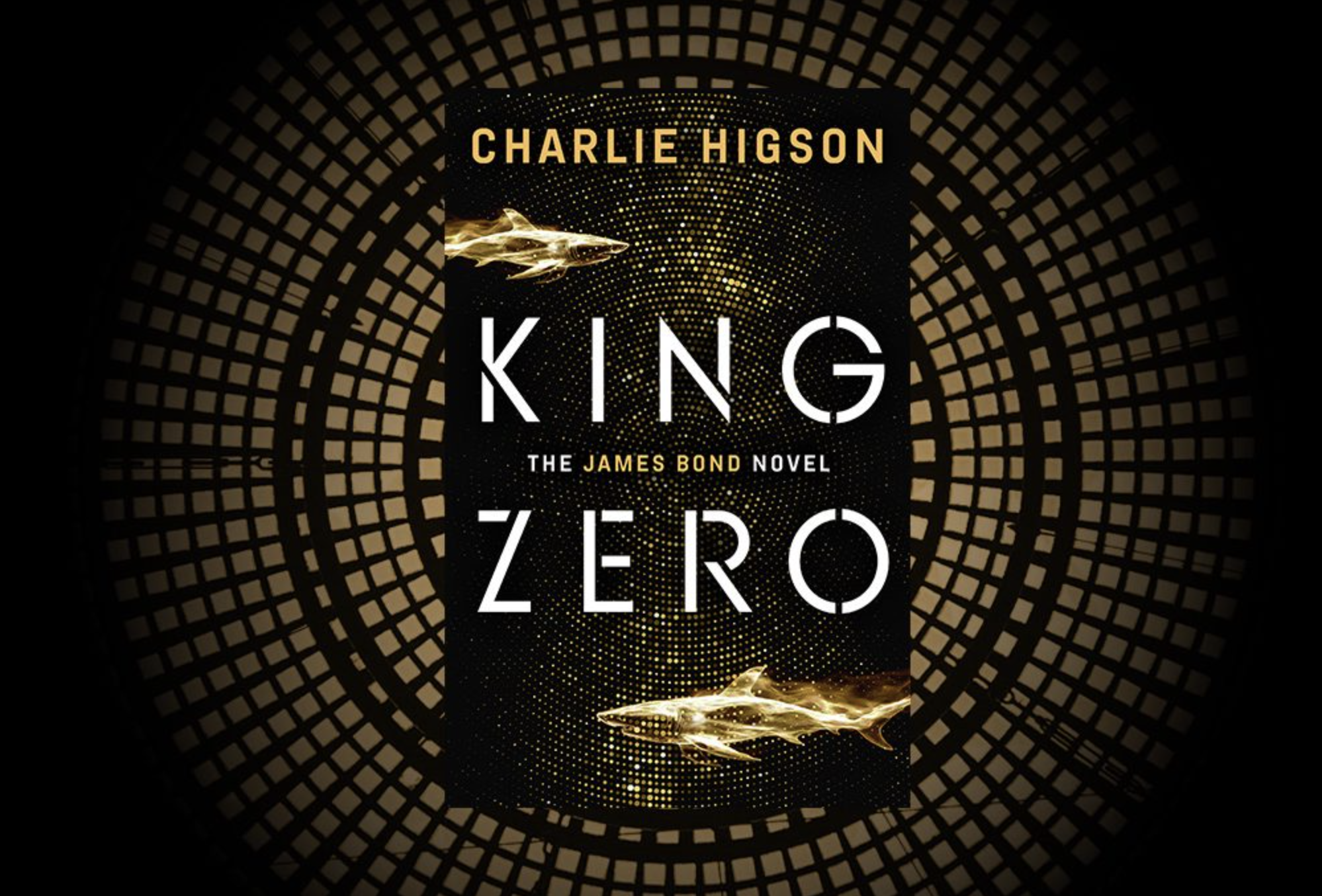
Reviewed: King Zero by Charlie Higson
In the acknowledgements of King Zero, author Charlie Higson uses the verb “graduate” to describe his transition from writing Young Bond to writing adult Bond. It is an apt choice, for his follow up is most definitely a Bond book for grown-ups.
This review contains no plot spoilers
When it comes to writing James Bond novels, this is hardly Higson’s first time. In fact, this is his 007th.
As well as being the creator of the Young Bond series (he wrote the first five, of a total of nine, plus a short story included in Danger Society: The Young Bond Dossier), he has already forayed into adult Bond with the highly successful - and controversial - On His Majesty’s Secret Service. This book was published in May 2023 to commemorate the coronation of King Charles and raise money for the National Literacy Trust. On the shorter end of the 007 novel spectrum (being roughly the length of Casino Royale and The Man With The Golden Gun, Fleming’s first and last Bond novels) this was nevertheless a complete Bond story and breathlessly exciting. I read it in one sitting.
If only everyone who had an opinion about this book had actually read it. Upon publication, it caused some consternation for turning Bond into a “woke, libtard snowflake”. The evidence for these accusations? Higson’s Bond was merely reflective of the lives of many real life 35 year olds in keeping fermented foods in his fridge (kombucha, kimchi) and being opposed to tyrants who pose as men of the people, exploiting patriotic sentiment for their own ends. It was felt in some hellish circles of the internet (to invoke an image from Dante) that Higson had gone too far in making Bond ‘left wing’, despite Ian Fleming pinning his creation’s political leanings in this direction sixty years previously. (While Fleming’s Bond does his best to avoid getting enmeshed with politics in the original novels, his actions on the whole indicate a ‘slightly left of centre’ stance, which Fleming himself articulated in his final interview, published in Playboy magazine, posthumously. I explored this more fully here.)
Perhaps this small (but irritatingly vocal) minority of so-called ‘Bond fans’ found On His Majesty’s Secret Service disconcerting because it held a mirror up and they did not like what they saw reflected back at them. I cannot help think of that famous sketch from comedy duo Mitchell and Webb, of which Higson is an acknowledged fan: two officers of Hitler’s SS debating whether they might actually be the baddies.
Specific passages of On His Majesty’s Secret Service, divorced from the story as whole, were circulated online by this vocal minority to make their case that Higson had ‘woke-ified’ Bond, despite the fact that - as Higson himself rebutted in The Guardian - Bond has always been a “complicated character”: he’s neither especially one thing nor another. Even so, one can only imagine the consternation that certain sections of King Zero are going to cause among people who insist on hijacking 007 to validate their polarised view of the world.
But Bond is at his best when he’s neither everything nor nothing. For instance, he’s not a sexist misogynist dinosaur but neither is he excessively restrained. He won’t have sex with a woman who is being coerced into sleeping with him but, when he’s the object of genuine desire, his body will respond in the predictable way of most ‘warm-blooded’ creatures - and he won’t always make the wisest of choices in these situations.
Higson gets this completely: the ambiguity of the character is something he really leans into in King Zero. On several occasions, Bond cries, but only to himself or when he can conceal his tears from others. When he makes a catastrophic mistake during a mission he’s full of self-recrimination. But, true to Fleming form, when he’s going through hell, he keeps going, summoning the mental reserves to make up for his missteps.
One of the questions hovering over King Zero is whether Higson’s second adult Bond is a direct continuation of his previous adventure. The answer is a resounding yes, with continuity established with On His Majesty’s Secret Service relatively early in King Zero. And even though the Young Bond series is set nearly a century before Higson’s adult Bond adventures, Higson knowing his way around Eton (both the physical place and what it represents in Bond’s life) bears fruit here.
This is Higson’s Bond universe, with its own backstory and continuity, just as we’ve recently had Sherwood’s Bond universe and, to an extent, Benson’s Bond and Gardner’s too, each time updated for the era. This is also very much a story by Charlie Higson. Fleming was a master of unsettling this audience via uncanny imagery but there is no word in the English language which captures exactly that mix of disgust and comedy which Higson so adroitly places on the page in King Zero. We might have seen this coming: there are parts of the Young Bond books which can be described as ‘grotesque’ or ‘macabre’, even for older readers. But in King Zero, unrestrained by the intended demographic of his audience, Higson pushes further into horror than any Bond author has gone before. From the surgical detail of the opening through to the sickeningly scatalogical reveal of a villain, this is not a Bond novel for the squeamish. But it is a Bond novel for those with a sense of humour. On each horrifying occasion, I found myself almost laughing aloud at the Grand Guignol glee Higson brings to proceedings. He’s clearly having so much fun throughout. I particularly enjoyed the running gag involving Spotify.
Like Fleming’s Bond books, King Zero is both a Bond story for a modern age and for all ages. While the technology around 007 will inevitably date, the largely immutable core of the tale is Bond himself. And while some of the villains may call to mind certain individuals in the real world of today, they are manifestations of age-old ills which have blighted the human race for all of recorded history, and possibly before.
Much has been made of the writer of the new Bond film, Steven Knight, stating that he sees Bond as a “modern myth”. Fleming himself was very aware of his creation’s mythical qualities and this is something Higson runs with, while also making him even more recognisably human. It’s a tricky balancing act, but Higson pulls it off, right down to the emotionally grown-up finale. No spoilers, of course, but for me it felt like the sort of ending Fleming might have written had he still been around (somehow, at the ripe old age of 118) and writing Bond today.
It’s a shame, really, that not everyone who forms an opinion about King Zero will actually read it. There will be specific sentences and paragraphs which that small (but vocal) minority will excerpt to make childishly reductive claims about Bond going ‘woke’ - again!
Anyone who does pick up King Zero will discover a Bond story which is as thrilling as it is relevant, as exciting as it is emotionally resonant. Above all, King Zero goes to show that - and this is almost an adage at this point, which this novel gives significant credence to - James Bond should, and always will, return.
If On His Majesty’s Secret Service represented Higson’s transition from undergraduate to graduate, his follow-up is his Masters.